A swashbuckler with a Hong Kong pulse, shot by its own director in the candle-and-rain palette of a thriller. Here is what you are watching, and why it looks the way it does.
The Film and What It Is
Peter Hyams directed The Musketeer in 2001, working from a screenplay by Gene Quintano that takes Alexandre Dumas's 1844 novel The Three Musketeers as its foundation and then rearranges the furniture. The result is a film that arrives in familiar company — D'Artagnan, Athos, Porthos, Aramis, the scheming Cardinal Richelieu, the enigmatic Milady — and proceeds to do something distinctive with them: it grafts Hong Kong action choreography onto seventeenth-century French swordplay, hands the whole enterprise to a director who operates his own camera, and shoots it through a palette so dark and rain-soaked that it plays less like a romantic adventure than a period thriller with acrobatic sword fights.
What is immediately apparent, even from the opening minutes, is that Hyams is not interested in the bright, sun-drenched swashbuckler that the Dumas name tends to conjure. The film opens in the past, in a cold rural scene that establishes young D'Artagnan witnessing his parents' murder at the hands of agents working for a man who will become his enemy in manhood. This prologue — largely an invention of the screenplay rather than a Dumas inheritance — sets a darker emotional register from the first frames, one the film sustains through its palace intrigue and its spectacularly staged fights. The novel it draws on and how much of it survives is, in itself, a long conversation; this film is not pretending to be a faithful adaptation. It takes what it needs and moves on.
Justin Chambers plays D'Artagnan, newly arrived in Paris, burning to join the Musketeers. Stephen Rea is Cardinal Richelieu, the political schemer pulling strings behind the throne. Catherine Deneuve plays the Queen, Anne of Austria, whose cache of letters drives the central intrigue. Tim Roth is Febre, the Cardinal's swordsman, who functions here as the film's primary action antagonist. Mena Suvari plays Francesca, a love interest. Together they populate a version of Dumas's world that is compressed, streamlined and pointed firmly toward its set pieces — which is not a criticism, only a description of priorities.
Key facts, in passing
- cinematographer
- person responsible for a film's visual image and camera work
- action choreography
- planned, rehearsed design of fight and stunt sequences
- wire work
- stunt technique using concealed wires to enable actors to perform gravity-defying movements
- period thriller
- thriller set in a historical period, often darker in tone than period romance
A Palette Unlike the Others
Go through the canon of Three Musketeers adaptations and a pattern emerges: the tendency is toward warmth, toward comedy, toward the kind of lustrous production design that announces, unmistakably, that you are watching a classic literary adventure. Richard Lester's pair of films in the 1970s played the material for satirical buffoonery. The 1993 Hollywood version swapped doublets for action-movie energy and a pop soundtrack. Even the grander, more earnest versions lean toward the ceremonial — the gold braid, the rearing horses, the sun on stone. The Musketeer (2001) looks, tonally, like none of these.
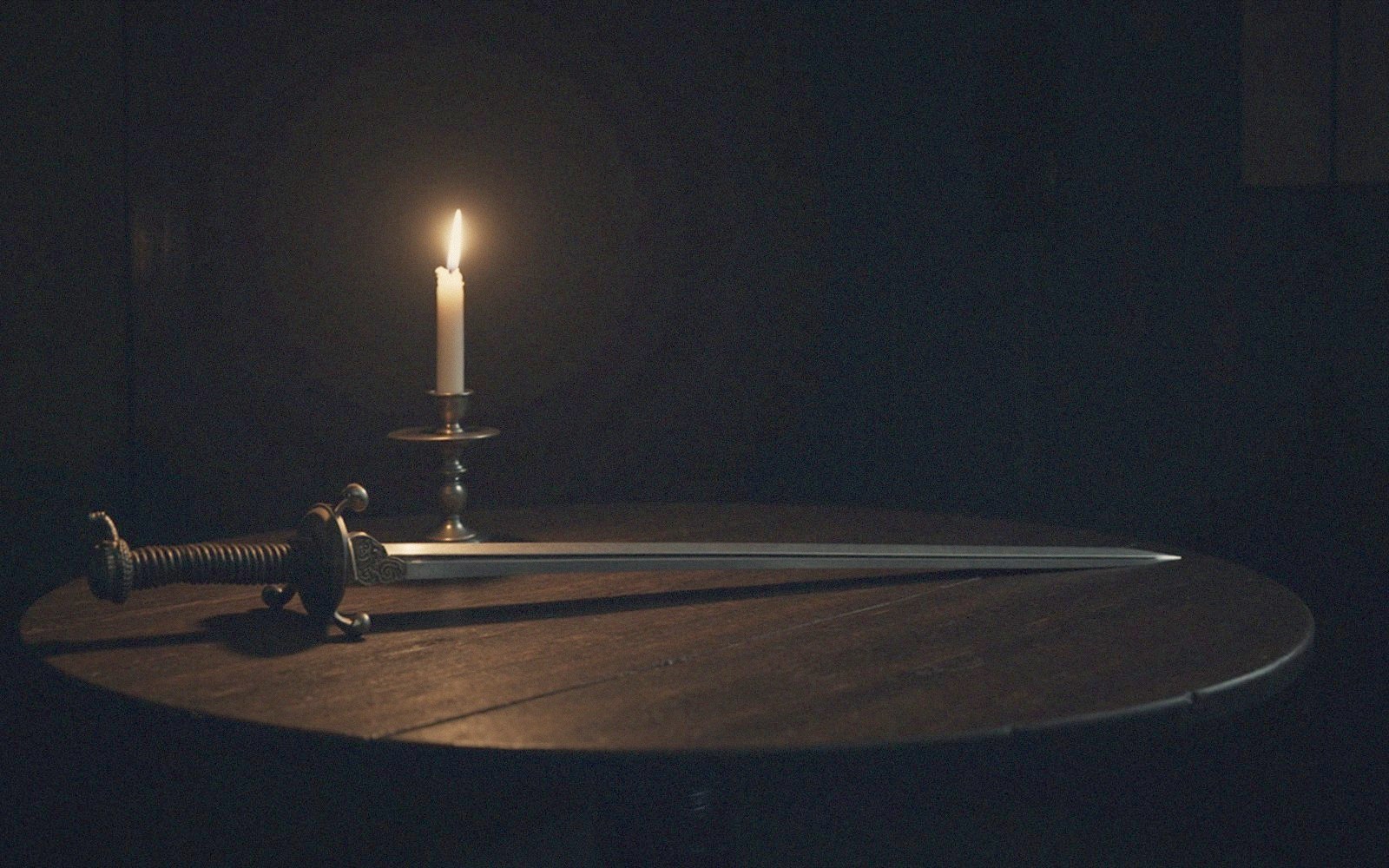
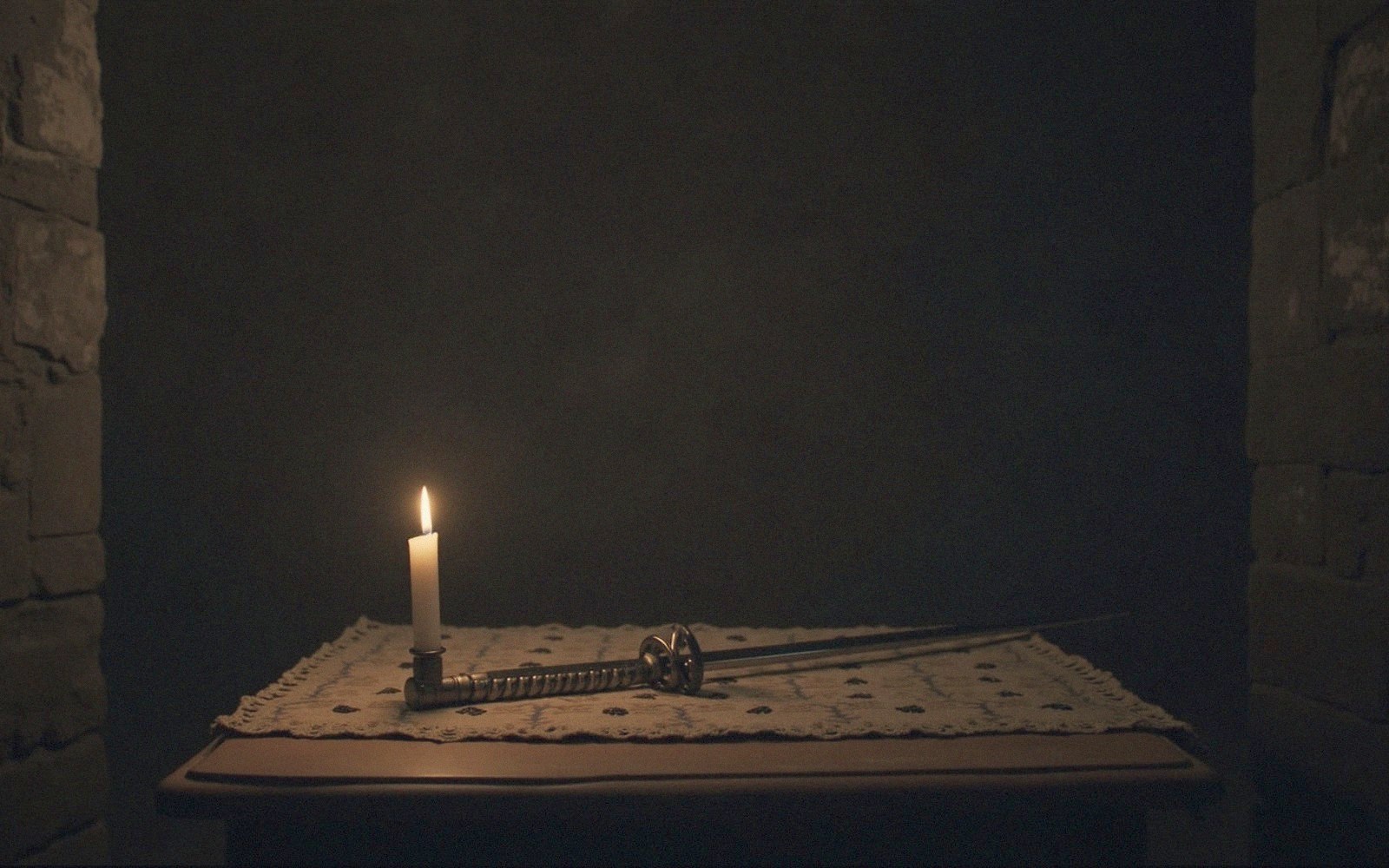
The reason is Hyams. He has spent his career as both director and cinematographer on his own films, and that double role produces a particular result: the image is not what a director asks a separate eye to give him, but what the director himself finds in the viewfinder. On this film, Hyams brought a lighting sensibility closer to his crime and thriller work than to a period romance — candlelight and shadow, rain-slicked exteriors, interiors that barely push back the dark. The visual language of the film repays close attention precisely because it reads as a conscious refusal of the conventional Dumas look, not a budget limitation or a studio accident.
That choice shapes everything downstream. When D'Artagnan fights in a tavern or a barn or along a ladder suspended from a mill, the choreography — designed by Xin-Xin Xiong, the Hong Kong action director whose credits include work with Jet Li — lands differently than it would in bright theatrical light. The speed of the fighting feels more physical, more dangerous; the spatial geometry becomes harder to read at first glance, which in turn makes the resolution of each exchange more satisfying. The film's visual grammar is doing active work, and the palette is part of the argument.
A Dumas adaptation that decided the important question was not how faithful it could be, but how well it could fight.
What the Film Attempts
The Musketeer is reaching for something that most adaptations of Dumas have not tried: the synthesis of the Hong Kong martial arts film and the European period adventure. Wire work brought to Dumas the grammar of a cinema tradition where the body's relationship to gravity is negotiable — where a fighter can ascend a vertical surface, leap between platforms, be hurled through the air and land fighting. None of that physics belongs to the seventeenth century, and none of it pretends to. The film is not arguing for historical accuracy in its action sequences. It is arguing that the kinetics of Hong Kong action choreography can generate the same quality of wonder in a doublet as in a gi, and that what audiences want from a swashbuckler is not fencing-hall realism but legible, escalating, physically astonishing spectacle.
The ladder fight — the extended sequence involving a functioning mill and a ladder used simultaneously as arena, obstacle and weapon — is the clearest statement of this intention. It is the sequence most people who have seen the film remember longest, and it is worth understanding as a piece of action filmmaking rather than just a highlight reel moment. The geography of the space is established clearly before the fighting begins; the choreography exploits that geography at every stage; each combatant's position on the ladder changes the tactical situation and the visual composition simultaneously. It is constructed, not improvised — the result of Xiong's choreography meeting Hyams's camera work — and it remains among the more inventively staged fights in early 2000s action cinema.
Whether the film entirely succeeds in binding these elements into a coherent whole is a fair question. The screenplay gives Rea's Richelieu less room than the performance seems to want. The romance between D'Artagnan and Francesca does the conventional duty expected of it without generating much heat. The pacing in the film's middle section — between the Parisian arrival and the final convergence of plots — can feel compressed at points where more breathing room might have sharpened the stakes. These are real weaknesses, and a reader of this guide who comes to the film for the fights should not expect the drama to sustain equal tension throughout.
- 1844Alexandre Dumas publishes The Three Musketeers
- 2001The Musketeer released theatrically; September release date
Why It Looks Unlike Other Dumas Pictures
Three things distinguish The Musketeer visually from its competition in the adaptation field, and they are worth naming plainly.
First, the cinematography is Hyams's own. A director-cinematographer is his own collaborator on the image, and the result here is a coherence between camera placement and choreography that comes from a single sensibility making decisions about both. When the camera moves through a fight, it is moving because the person who staged the fight's visual coverage and the person holding the camera are the same individual, working out in real time what serves the sequence.
Second, the Hong Kong action vocabulary was applied by someone with genuine expertise in it. Xiong is not a Hollywood stunt coordinator working from YouTube reference; he was operating within a tradition — wire-enhanced choreography, spatial storytelling through physical escalation — that he knew from the inside. The visible result is that the stunts have a different structural logic than Western action films of the era typically produced.
Third, the production design and locations — much of the shoot took place in Luxembourg and Germany — gave Hyams stone interiors and practical outdoor settings that could absorb his low-key lighting without losing period credibility. The world feels inhabited rather than constructed, which is not incidental to the film's tone. A period film that reads like a studio set reads like a fantasy; a period film that reads like a real place reads like history, or at least like the memory of it. This one, for all its wire-assisted physics, tends toward the latter.
The film was released in September 2001 and received a mixed critical response, landing as something critics found hard to categorize — too stylized for straightforward adventure audiences, too dependent on conventional plotting for action-cinema devotees. Its reputation has, among viewers with a specific interest in action choreography and in the intersection of genre traditions, continued to build quietly in the years since. For that audience, it remains a genuinely interesting object: a Dumas adaptation that decided the most important question was not how faithful it could be, but how well it could fight.
Who is in this piece
Peter Hyams
director and cinematographer of the film
Justin Chambers
plays D'Artagnan
Tim Roth
plays Febre, the Cardinal's swordsman
Catherine Deneuve
plays Queen Anne of Austria
Stephen Rea
plays Cardinal Richelieu
Mena Suvari
plays Francesca, D'Artagnan's love interest