One sequence to define the film
If you come to The Musketeer knowing nothing about it, the ladder fight will tell you everything you need to know within its first thirty seconds. It is the film's signature sequence — the set piece that got the most attention on release, that still surfaces whenever the film is discussed, and that represents the clearest statement of what director Peter Hyams and fight choreographer Xin Xin Xiong were trying to accomplish by grafting Hong Kong action grammar onto a seventeenth-century adventure. It is not the longest fight in the film. It is the most completely realised.
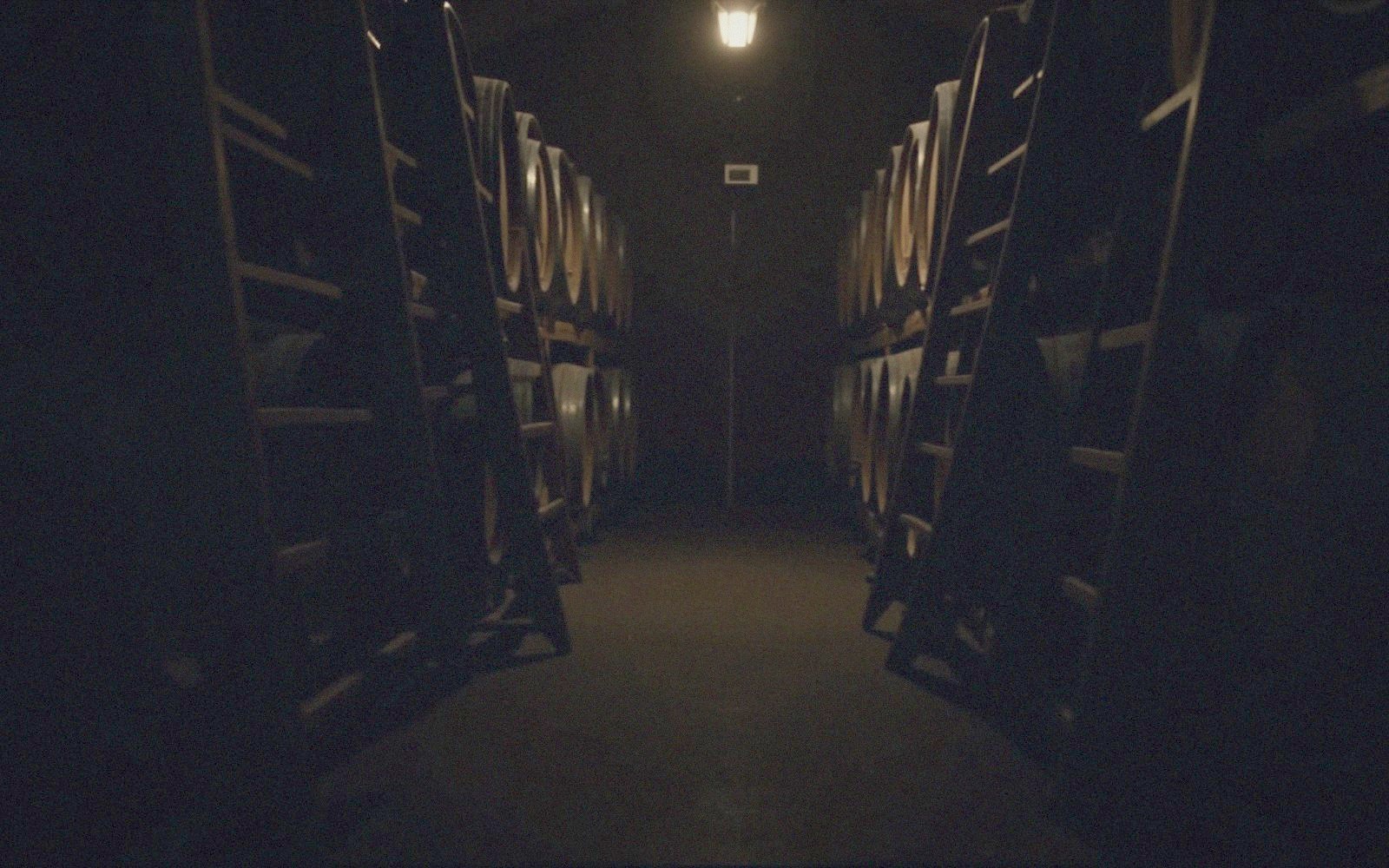
The sequence takes place in a wine cellar. Athos, d'Artagnan and their allies are cornered by Cardinal Richelieu's guards — a numerically overwhelming force in a confined space. The geography is established quickly: rows of enormous wine barrels stacked on tall wooden racks, connected by tall rolling ladders of the kind you find in old libraries or warehouses. The ladders are not props introduced for the fight; they belong to the logic of the space. That grounding matters. One of the consistent complaints about wire-enhanced action is that the physics feel arbitrary, detached from the world the characters inhabit. Here the choreography uses an object that has a self-evident reason to be there, and that produces a set of movement possibilities — rolling, swinging, tilting, leaping — that feel discovered rather than designed, even when every beat was plainly planned to the inch.
Key facts, in passing
- wire work
- stunt technique using rigged cables to extend a performer's movement range
- speed-ramping
- variable-frame-rate technique that accelerates or slows footage for dramatic effect
- set piece
- a self-contained action or dramatic sequence designed as a highlight of a film
How the sequence is built
The fight opens in close quarters, swords clashing in the narrow aisles between the racks. Justin Chambers's d'Artagnan is the film's kinetic centre of gravity, and the early exchanges establish his style: fast, slightly reckless, more instinct than training. The guards are numerous and come from multiple directions, which forces a mobile defence rather than a duel. Hyams — who also served as his own cinematographer, a working method that shapes how the sequence is framed and cut — keeps the camera close enough to read individual exchanges while pulling wide at precisely the moments when the spatial relationships between fighters and ladders need to register. The editing is measured. The temptation in this kind of sequence is to accelerate the cutting until the geography dissolves, but Hyams resists it. You can follow where everyone is.
The first major escalation comes when d'Artagnan takes to one of the ladders. The ladder rolls along its track, carrying him laterally while he fights opponents on the ground and on adjacent racks simultaneously. What makes the beat work is simultaneity: he is moving, they are moving, and the geometry keeps shifting. A stationary duel has a fixed set of angles; a rolling ladder multiplies them continuously. The choreography exploits this by having guards attempt to board the ladder, fall from it, use it as cover, and attack from beneath it — so the ladder itself becomes a contested object rather than merely a platform. Wire work enables the more extreme displacements — the swings, the drops, the recoveries that defy normal friction — but the underlying conception is spatial rather than spectacular: control the ladder, control the aisle, control the fight.
The sequence's mid-section is where the density peaks. Multiple ladders are now in motion, and the choreography coordinates fighters across three vertical levels — ground, mid-rack height, and the top of the barrel stacks. Hyams's cinematography is plainly comfortable with vertical space; he frames from below to emphasise height and from above to show the plan of the cellar, and the cuts between those perspectives give the sequence a three-dimensional quality that flat coverage would forfeit. The barrel racks themselves become obstacles, cover and weapons: barrels are knocked loose, roll, destabilise footing. The set is doing work throughout, which keeps the sequence from becoming an abstract display of skill performed against a neutral background.
Tim Roth's Febre is not in the cellar. The ladder fight belongs entirely to the heroes and the anonymous guards, which is both a structural choice and an action-cinema convention. The villain is preserved for a different kind of confrontation. What the guards provide is volume — the sense that d'Artagnan and his companions are genuinely threatened, that the numerical disadvantage is real. The choreography honours that threat rather than trivialising it. Guards are not dispatched in single easy strokes; they keep coming, they adapt, some of them climb. The sequence sustains jeopardy across its full length without resorting to the common cheat of having opponents obligingly queue up and wait their turn.
Interactive · six beats
Step the sequence
Click a beat, or use the arrow keys. The schematic is ours, not a traced frame.
A Western fight arranger choreographs two men. Xiong choreographs two men and a building.
The final beats and what they achieve
The sequence resolves through exhaustion and attrition rather than a single climactic stroke, which is relatively unusual for a set piece of this ambition. There is no finishing flourish with swelling music and a freeze-frame. The cellar is cleared incrementally, the last guards dealt with as the others were — by movement, improvisation and the intelligent use of the space. The tonal choice matches the film's overall approach to d'Artagnan: he is not yet the finished article, not a legendary chevalier operating in a register of superhuman cool. He wins because he keeps finding angles, not because he is beyond being troubled.
What the ladder fight accomplished in terms of the film's reception was to provide a proof of concept. Genre critics and action specialists who were otherwise ambivalent about the film's storytelling found the sequence genuinely impressive. It demonstrated that the fusion Hyams and Xiong were attempting — Hong Kong spatial choreography, European period setting, real steel — could produce something that belonged to both traditions without being a pastiche of either. The baroque athleticism of the wire work is filtered through the grime and confinement of a working wine cellar; the effect is not a stunt reel dropped into a costume picture but a sequence that feels embedded in the physical world of the film.
Whether the rest of The Musketeer fully lives up to this sequence is a legitimate question, and reviewers at the time asked it. But the sequence itself holds. Watched now, it remains a precise, inventive piece of action filmmaking: economical in setup, rigorous in geography, confident in the camera, and committed to the proposition that physical space — not digital enhancement, not speed-ramping, not intercutting with reaction shots of spectators — is the fundamental resource of great screen combat. The ladders roll, the levels multiply, the geometry keeps changing. That is the whole idea, and it works.
- 2001The Musketeer released; ladder fight sequence identified in reviews as the film's signature action moment
Who is in this piece
Peter Hyams
director and cinematographer of The Musketeer (2001)
Justin Chambers
plays d'Artagnan
the kinetic centre of the ladder fight sequence
Tim Roth
plays Febre
absent from the cellar sequence
Xin Xin Xiong
fight choreographer on The Musketeer