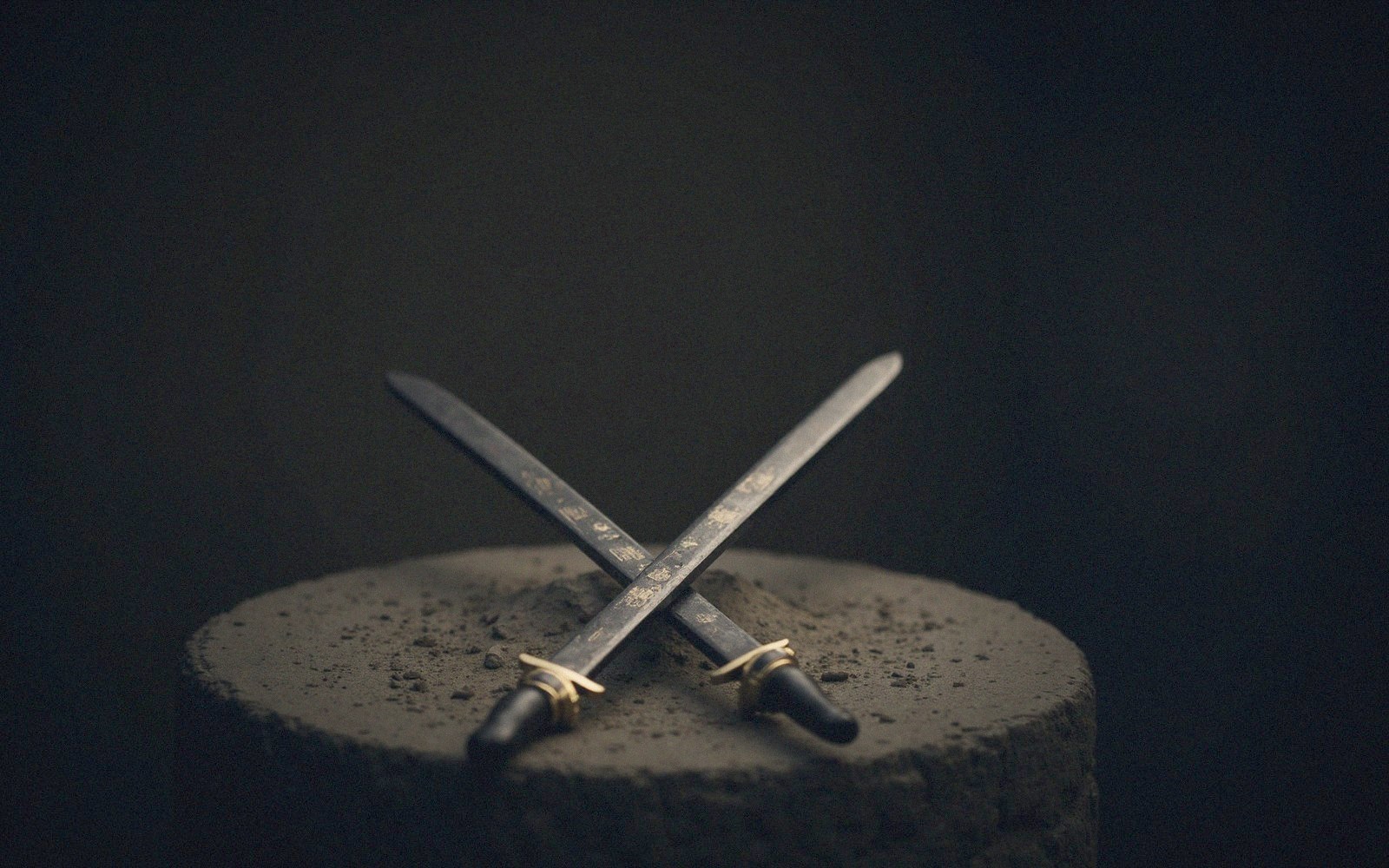
When fencing technique gives way to movement design — and why The Musketeer lands in between
In most action films set with swords, the question of authenticity quietly resolves itself: either nobody involved cares about historical fencing, or a single technical adviser tidies the edges. The Musketeer (2001) occupies more complicated ground. It recruited Xin Xin Xiong, a martial artist and action director from the Hong Kong film tradition, to design its fights — a decision that placed the film at a deliberate crossroads between period swordplay and pure choreographic spectacle. Understanding where that line sits, and where The Musketeer chooses to cross it, tells you most of what you need to know about how the film works as action cinema.
Key facts, in passing
- rapier
- slender thrust-dominant sword of the sixteenth and seventeenth centuries
- wuxia
- Chinese genre tradition emphasising acrobatic martial arts and wire-assisted movement
- measure
- fencing term for the controlled distance between two opponents
- choreography (fight)
- designed sequence of movements for performance, distinct from real combat technique
What fencing actually is — and isn't
Historical European fencing, as practiced in the seventeenth century, is not primarily dramatic. It is a system for killing an opponent efficiently: structured footwork, tight measure, controlled blade engagement. The rapier, the dominant weapon of the era the film depicts, demands a relatively narrow, upright stance with the sword arm extended. Engagements are short. The decisive exchange often lasts seconds. Watching two skilled historical fencers work is absorbing if you know what to look for, but it does not read well in a wide shot, and it offers very little of what a camera hungers for — sustained motion, dramatic silhouette, spatial variety.
Stunt choreography approaches the same swords from a completely different direction. Here, the primary material is movement: what the two bodies do in relation to each other, to the space, to the architecture around them. Technique matters insofar as the performers must not injure each other and must hit their marks, but the governing logic is visual and rhythmic, not martial. A high parry that would leave a historical fencer open for half a second is perfectly acceptable if it reads beautifully in frame.
Peter Hyams, who directed The Musketeer and also operated camera himself throughout, was shooting for the second register. His background is in thriller cinematography, and the fights in this film are conceived as images first. That means the choreography Xin Xin Xiong designed had to be legible in the kind of tight, dynamic framing Hyams preferred — a very different brief from "what would a seventeenth-century swordsman actually do."
Fencing asks what a blade can do. Choreography asks what a room can do to a blade.
The Hong Kong grammar and what it imports
The specific tradition Xin Xin Xiong brought to the film is wuxia-influenced action choreography: a vocabulary that emphasizes continuous motion, environment as obstacle and tool, and the kind of vertical thinking — up onto tables, over beams, against walls — that European sword-cinema had historically avoided. This grammar carries with it certain assumptions. Weapons become extensions of acrobatic bodies. Space is exploited fully: floor, wall, ceiling, hanging object. Sequences are composed in beats, with deliberate pauses and accelerations, rather than in the continuous, unbroken pressure of a real engagement.
Applied to a Dumas story, this creates a recognisable hybrid. The ladder fight, the film's set-piece showpiece, uses a construction site as its arena — not because historical musketeers were likely to duel on scaling ladders, but because the environment permits a vertical sequence in which the choreography can breathe and develop across multiple planes. That decision is pure Hong Kong action logic. The swords themselves, in that sequence, are almost secondary to the bodies and the architecture.
Justin Chambers, cast as D'Artagnan, came to the role without deep fencing training and prepared specifically for the choreography Xiong designed — a significant distinction. He learned to perform these sequences convincingly as a physical actor, not to fence. The results show in the best moments: his movement reads as instinctive and propulsive rather than studied.
Why the hybrid works — and where it strains
What Hyams and Xiong achieve, at their best, is a kind of physical plausibility that pure Hong Kong wire spectacle would lose in this setting. The film does not ask its performers to fly. It keeps its wire work subtle enough that the geography remains comprehensible. The fights feel located in the real world even when the choreography has clearly departed from anything a seventeenth-century swordsman would recognise.
Where the hybrid strains is in the connective tissue — the quieter exchanges that bracket the set pieces. When the film must deliver ordinary sword engagement without a spectacular environment to motivate the choreography, the gap between fencing and movement design becomes visible. The performers look like they are performing sequences rather than fighting, which is, in the end, exactly what they are doing. That is not a failure unique to this film; it is the honest cost of choosing spectacle as the primary value. In The Musketeer, that choice is made consciously, and the best sequences justify it entirely.
The rail · where the handover happens
Five beats from fencing to choreography
Every exchange in this film starts as swordplay and ends as staging. The handover is visible if you know where to look.
- 01Guard, and the fencer’s distanceThe exchange opens at measure — two blades, a step, an invitation. This part belongs to fencing and is judged by fencing’s rules.
- 02The beat and the parrySteel on steel, a real vocabulary with real names. It is also the last moment where the fight could plausibly happen the same way twice.
- 03The break in distanceOne combatant closes past measure, where a rapier is a liability. Fencing has no answer here; choreography does, which is precisely why the film keeps engineering it.
- 04The room takes overA bench, a barrel, a rung, a rolling ladder. From this beat the sequence is being solved by the set, and the blade is one prop among several.
- 05Back to guardThe return to measure is the tell that the beat is finished. Xiong’s sequences almost always land back on a fencing image, which is what keeps a wire-assisted fight legible as a duel.
The numbering and the terms are ours. Fencing terms are used in their ordinary sense; nothing here is a claim about the shot list.
Who is in this piece
Xin Xin Xiong
Hong Kong martial artist and action director
fight choreographer on The Musketeer
Peter Hyams
director of The Musketeer
also served as his own cinematographer
Justin Chambers
actor
plays D'Artagnan, the film's central protagonist